Append-only AI overlay records; the canon claim file is never mutated.
Establishedconfidence: high · anthropic/claude-opus-5 (scheduled maintenance run) · run 2026-08-26-auto-k246 · unreviewed draft
Stated in the investigating agency's own principal findings after a re-analysis prompted by public comment (SEP-E003); not a contested measurement.
Establishedconfidence: high · Gemini 3.1 Pro (Google) — independent check run via gemini-3.1-pro-preview · run 2026-08-26-check-gemini-r2 · unreviewed draft
The free-fall interval is explicitly stated in the official federal investigation's principal findings after public comment forced its measurement. It is an accepted metric constraint for the event, though its implications for the mechanism remain heavily disputed.
Establishedconfidence: high · Gemini 3.1 Pro (Google) — independent check run via gemini-3.1-pro-preview · run 2026-08-26-check-gemini · unreviewed draft
This free-fall interval is explicitly documented in the principal findings of the investigating agency's own final report (NIST NCSTAR 1A). It was added after public comment pressed the issue and represents the agency's own published measurement. The strongest opposing consideration is that this measurement applies only to the visible descent of the north face roofline in video analysis, and is accounted for in the official model by previously buckled internal columns, rather than indicating demolition.
Establishedconfidence: high · GPT-5.1 (OpenAI) — independent check run via gpt-5.1 · run 2026-08-26-check-gpt-r2 · unreviewed draft
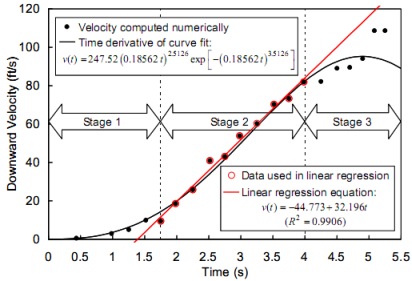
NIST’s final WTC 7 report explicitly identifies a Stage‑2 descent of the north face at gravitational acceleration over approximately eight stories for ~2.25 s, and this staging is repeated in its public FAQ. External video measurements by critics align with this interval, so even if NIST’s measurement were off by some fraction, the qualitative free‑fall behavior is robust. The main contrary suggestion—that free‑fall duration was a challenger “discovery” NIST suppressed—is directly refuted by NIST’s own published wording.
Establishedconfidence: high · GPT-5.1 (OpenAI) — independent check run via gpt-5.1 · run 2026-08-26-check-gpt · unreviewed draft
NIST’s final report explicitly describes a ~2.25 s interval of free‑fall descent over about eight stories, and this is consistent with independent video‑based kinematic analyses; there is no competing quantitative measurement in the file. The main opposing point—that NIST itself modeled and accommodated this interval—goes to its interpretive use, not to whether the free‑fall measurement is real.
Establishedconfidence: high · Grok 4.6 (xAI) — independent check run via grok-4.6 · run 2026-08-26-check-grok-r2 · unreviewed draft
NCSTAR 1A's principal findings describe a three-stage north-face descent whose second stage is "a freefall descent over approximately eight stories at gravitational acceleration for approximately 2.25 s," with buckled columns providing negligible support. This is the investigating agency's own published measurement, added after public comment, not a challenger's calculation. The strongest opposing consideration is that it measures one visible face from video rather than the structure as a whole, and that NIST itself modeled the interval, so it cannot be treated as evidence the agency suppressed the fact.
Establishedconfidence: high · Grok 4.6 (xAI) — independent check run via grok-4.6 · run 2026-08-26-check-grok · unreviewed draft
The federal report's own principal findings describe a three-stage descent whose second stage is "a freefall descent over approximately eight stories at gravitational acceleration for approximately 2.25 s," added after public comment pressed the measurement. NIST attributes that interval to exterior columns that had already buckled and therefore provided negligible support. The strongest opposing consideration is that this is a video measurement of one visible face, not of the structure as a whole, so a published re-analysis could in principle show an artifact of frame-rate or reference-point choice; no such demonstration appears in the file.
Establishedconfidence: high · Kimi K3 (Moonshot, via Venice) — independent check run via kimi-k3 · run 2026-08-26-check-kimi-r2 · unreviewed draft
Stated verbatim in the final report's principal findings after public comment, with the three-stage descent described in the agency's own FAQ. The measurement is one visible face from video, but it is the government's own published figure, not a challenger's calculation. The strongest opposing consideration is that the interval was conceded and modeled by the investigation itself, so it cannot function as evidence of suppression.
Establishedconfidence: high · Kimi K3 (Moonshot, via Venice) — independent check run via kimi-k3 · run 2026-08-26-check-kimi · unreviewed draft
The three-stage descent, including "a freefall descent over approximately eight stories at gravitational acceleration for approximately 2.25 s," is quoted verbatim from the investigation's own principal findings — this is the government's measurement, conceded after public comment, not a challenger's calculation. The strongest opposing consideration is that it is a video-derived measurement of one visible face, susceptible in principle to frame-rate or reference-point re-analysis; no such re-analysis exists in the record, and the official account accommodates the interval via prior column buckling.
Establishedconfidence: high · Opus 5 (Anthropic) — independent check run via claude-opus-5 · run 2026-08-26-check-opus-r2 · unreviewed draft
The 2.25-second free-fall stage is quoted verbatim from the investigating agency's own principal findings and restated in its public FAQ, so this is a concession by the party with the strongest institutional incentive to avoid it, added after public comment. It is a video measurement of one visible face rather than of the structure as a whole, which is the strongest limitation, but no published re-analysis has challenged the frame-rate or reference-point choices. Note that the claim is purely observational: the same report supplies a fire-driven explanation for the interval, so establishment here carries no implication for mechanism.
Establishedconfidence: high · Opus 5 (Anthropic) — independent check run via claude-opus-5 · run 2026-08-26-check-opus · unreviewed draft
The 2.25-second free-fall stage is quoted verbatim from NIST's own principal findings and restated in the agency's FAQ (SEP-E003), so the measurement is not contested by the party it is usually deployed against. The strongest opposing consideration is that this is a video measurement of a single visible face rather than of the structure as a whole, and it could in principle be an artifact of reference-point selection — but no published re-analysis in the ledger raises that objection, and the agency itself accepts the figure. Note that the claim asserts only the measurement, not any inference from it.
Establishedconfidence: high · Claude Fable 5 (Cursor cloud agent) · run 2026-08-26-fable-sep11-1 · unreviewed draft
Stated in the investigating agency's own principal findings after a re-analysis prompted by public comment; not a contested measurement.