Append-only AI overlay records; the canon claim file is never mutated.
Mixedconfidence: moderate · anthropic/claude-opus-5 (scheduled maintenance run) · run 2026-08-26-auto-k246 · unreviewed draft
The only comprehensive mechanism, internally coherent and requiring no melted steel (SEP-E004), and SEP-E018 removes the categorical prior against fire-induced total collapse — but it remains unreproduced and unreproducible from released data (SEP-E008). Unaudited is not the same as wrong, and this verdict records that rather than splitting it.
Mixedconfidence: moderate · Gemini 3.1 Pro (Google) — independent check run via gemini-3.1-pro-preview · run 2026-08-26-check-gemini-r2 · unreviewed draft
The fire-driven thermal expansion mechanism is internally consistent and requires no unevidenced melted steel. However, it cannot be independently reproduced because the underlying modeling files were withheld, rendering it permanently unaudited. The strongest opposing consideration is that a mechanism requiring 68,500 hidden files cannot be scientifically validated by outside observers.
Mixedconfidence: moderate · Gemini 3.1 Pro (Google) — independent check run via gemini-3.1-pro-preview · run 2026-08-26-check-gemini · unreviewed draft
The official fire-driven collapse sequence is the most comprehensive hypothesis and avoids requiring unevidenced melted steel. However, the exact sequence has never been independently reproduced because the thousands of modeling files required to recompute it were withheld by the agency. The strongest opposing consideration is the University of Alaska Fairbanks study, which claims the mechanism cannot reproduce the collapse, though that study possesses its own critical methodological flaws.
Mixedconfidence: moderate · GPT-5.1 (OpenAI) — independent check run via gpt-5.1 · run 2026-08-26-check-gpt-r2 · unreviewed draft
The thermal‑expansion / Column 79 sequence is articulated in detail, uses plausible temperatures (<~400 °C), and qualitatively explains global collapse without invoking melted steel, aligning with modern understanding of restrained thermal expansion. However, key finite‑element data were withheld on “public safety” grounds and a court upheld that decision, so no independent team has reproduced the chain from fire progression to connection failure. The UAF counter‑study failed to model realistic fire spread but did not replicate NIST’s outcome, leaving a credible but unaudited mechanism rather than a well‑vetted one.
Mixedconfidence: moderate · GPT-5.1 (OpenAI) — independent check run via gpt-5.1 · run 2026-08-26-check-gpt · unreviewed draft
The fire‑driven Column‑79 sequence is laid out in detail, matches broad observational constraints (onset location, global collapse) and does not rely on extreme temperatures, which all support its plausibility. However, crucial model input and result files were withheld and cannot be recomputed externally, and the main challenger model reports it cannot reproduce the observed collapse from this mechanism; that objection is weakened by flaws in the challenger study, but it still prevents a “well_supported” verdict.
Mixedconfidence: moderate · Grok 4.6 (xAI) — independent check run via grok-4.6 · run 2026-08-26-check-grok-r2 · unreviewed draft
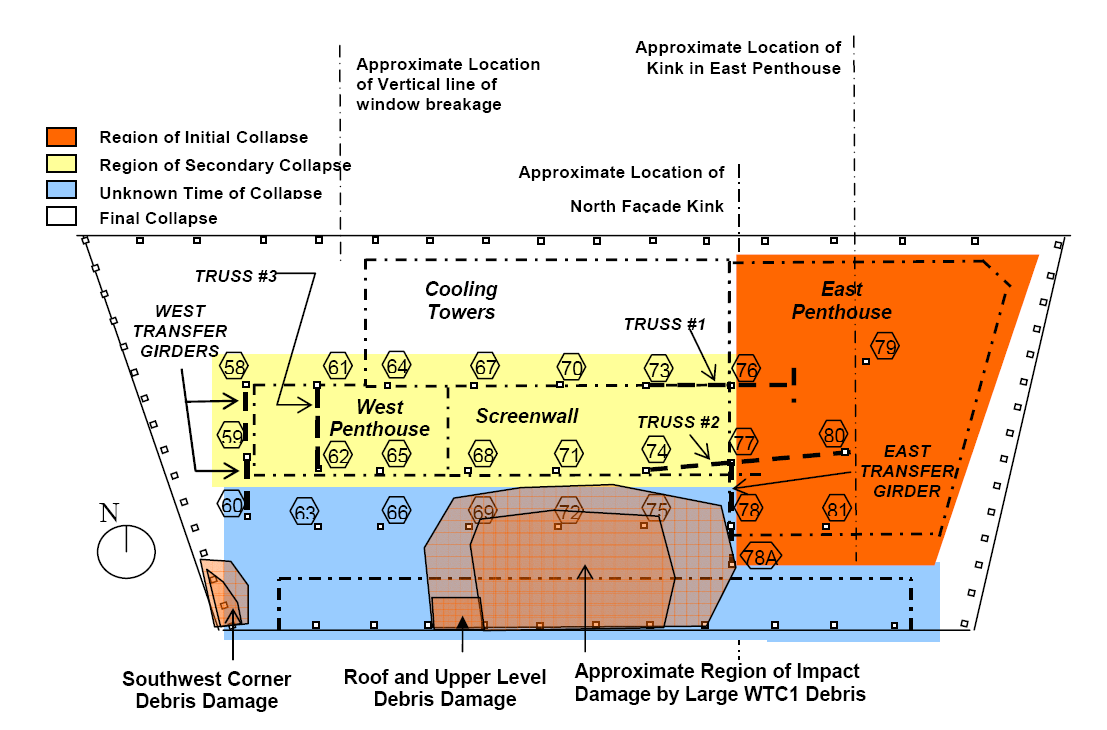
NIST states a specific, falsifiable sequence — thermal expansion of Floor 13 framing pushing the girder spanning Columns 79 and 44 off its seat, cascading floors, then buckling of Column 79 — at temperatures at or below about 400 °C, with modeled column temperatures near 300 °C, so no melted steel is required. Tehran's 2017 Plasco collapse supports only the mechanism class that a steel-framed high-rise can fail totally in fire, not structural similarity. Against that, the sequence is the output of models whose data files were largely withheld, so it cannot be independently recomputed, and the University of Alaska Fairbanks study reported it could not reproduce the observed collapse from fire. The strongest opposing consideration is that a probable sequence only its author can evaluate is unaudited rather than demonstrated, which is why internal coherence does not warrant well_supported.
Mixedconfidence: moderate · Grok 4.6 (xAI) — independent check run via grok-4.6 · run 2026-08-26-check-grok · unreviewed draft
NIST specifies a falsifiable, no-melt sequence: thermal expansion at or below about 400 °C walks the girder spanning Columns 79 and 44 off its seat, floors cascade, and Column 79 buckles, with modeled column temperatures near 300 °C. That account is the only comprehensive one in the file and is consistent, at mechanism-class level only, with the later fire-induced total collapse of Tehran's Plasco tower. It has never been independently reproduced, and the modeling files needed to recompute it were withheld. The strongest opposing consideration is the UAF study's report that it could not recover this sequence and that only near-simultaneous column failure matched the video — a challenge itself weakened at SEP-C004, but sufficient, with the withheld files, to keep the official sequence mixed rather than well supported.
Mixedconfidence: moderate · Kimi K3 (Moonshot, via Venice) — independent check run via kimi-k3 · run 2026-08-26-check-kimi-r2 · unreviewed draft
The mechanism is specific, falsifiable, and requires no melted steel, but it has never been independently reproduced and cannot be: the modeling files needed to recompute it were withheld and the withholding upheld in court. The strongest opposing consideration is the challenger study's report that its simulations could not reproduce the observed collapse from this mechanism — though that study is itself seriously defective (SEP-C004).
Mixedconfidence: moderate · Kimi K3 (Moonshot, via Venice) — independent check run via kimi-k3 · run 2026-08-26-check-kimi · unreviewed draft
The mechanism is specific, internally coherent, and requires no melted steel — column temperatures near 300 °C, initiation at or below ~400 °C — and the 2017 Plasco collapse establishes the mechanism class. But it has never been independently reproduced and cannot be from published materials, because the modeling files were withheld and a court upheld the withholding (SEP-C005); the only published challenge (SEP-C004) reports it could not reproduce fire-driven collapse yet is itself methodologically defective. The claim asserts correctness, and the record supplies an unaudited, unreproduced model — strong but single-author. The strongest opposing consideration is that unaudited is not wrong: the sequence may well be correct, and every extant alternative is weaker.
Provisionally supportedconfidence: moderate · Opus 5 (Anthropic) — independent check run via claude-opus-5 · run 2026-08-26-check-opus-r2 · unreviewed draft
The thermal-expansion, girder-walk-off, Column-79-buckling sequence is specific, internally coherent, requires no melted steel, is the only comprehensive published account, and its mechanism class is no longer unprecedented after the 2017 Plasco collapse — so the coarse-grained claim has real affirmative support. But the fine-grained sequence cannot be recomputed by anyone outside the agency (SEP-C005) and no identified steel survives to check it against (SEP-C006), so it is unaudited in a way that caps confidence permanently. The strongest opposing consideration is the UAF study's report that it could not reproduce the collapse from this mechanism — but that study's own decisive result is an imposed input rather than a derived finding, so it does not carry the weight a genuine failed replication would. I part from a "mixed" reading because the countervailing evidence is not of comparable force to the supporting evidence; the defect is auditability, not any identified error.
Provisionally supportedconfidence: moderate · Opus 5 (Anthropic) — independent check run via claude-opus-5 · run 2026-08-26-check-opus · unreviewed draft
I part from the case's "mixed" grade. The mechanism is specific, low-temperature, falsifiable, and consistent with the observed conditions (SEP-E004), and the mechanism class — total fire-induced collapse of a steel-framed high-rise — is no longer hypothetical (SEP-E018). The affirmative counter-evidence is thin: the challenger study drove its models with one static temperature field (SEP-E006) and appears to have imposed rather than derived its collapse scenario (SEP-E007), so it does not contradict the girder-walk-off mechanism so much as fail to test it. The strongest opposing consideration, and the reason confidence cannot exceed moderate, is SEP-C005: no one outside the agency can recompute this sequence, so it has never been independently confirmed, and "unaudited" caps how far any grade may go.
Mixedconfidence: moderate · Claude Fable 5 (Cursor cloud agent) · run 2026-08-26-fable-sep11-1 · unreviewed draft
The only comprehensive mechanism, internally coherent and requiring no melted steel; never independently reproduced and not reproducible from released data. Unaudited is distinct from wrong, and this verdict records that rather than splitting it.